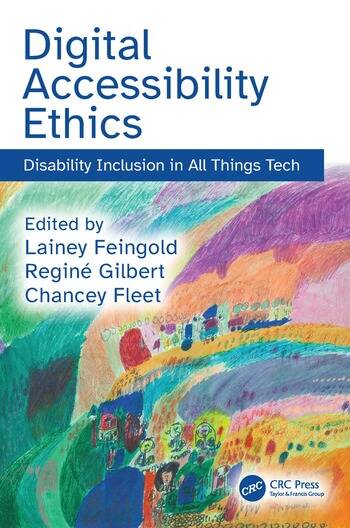
Digital Accessibility Ethics: Disability Inclusion in All Things Tech was published in May 2026 and has several Teach Access connections. The book was co-edited by Lainey Feingold, Reginé Gilbert, and Chancey Fleet. Feingold and Gilbert serve on the Teach Access Board of Directors and also wrote chapters in the collection. Contributing authors from Teach Access also include Executive Director Kate Sonka, Director of Education Rolando Méndez, and Board Vice President Meenakshi Das.
“As we say on page 1, this book is a practical guide with an urgent goal: to help make the digital world accessible to disabled people,” said Lainey Feingold. “Teach Access works to fulfill that goal every day with programming and content that has already reached 1.5 million students. As an editor, author, and Teach Access Board member, I look forward to engaging with the Teach Access community to make the goals of both the organization and Digital Accessibility Ethics: Disability Inclusion in All Things Tech a reality.”
The book brings together global leaders in accessibility, disability advocacy, and inclusive technology to advance a more ethical digital future. It features 32 chapters written by 39 disabled and nondisabled authors from 10 countries and one commonwealth. Collectively, the authors bring more than 600 years of experience in accessibility and disability advocacy.
Reginé Gilbert notes, “Teach Access exists because the next generation of technologists needs to learn accessibility before learned behaviors of exclusion take hold. Working on Digital Accessibility Ethics, with 39 contributors and one shared framework, reminded me why. How we build technology is an ethical question. Teach Access keeps that question alive in the places where it matters most.”
“Contributing the chapter Making Every Voice Heard: The Ethics of Voice Recognition Technology was a meaningful experience for me as someone who stutters and has personally experienced how technology can exclude disabled voices,” said Meenakshi Das. “It reinforced why I serve on the board of Teach Access — to help ensure the next generation builds accessibility and inclusion into technology from the start.”
The book introduces the Digital Accessibility Ethics Framework, an action-oriented three-part tool designed to disrupt disability exclusion in technology through values, actions, and critical questions. Authors apply the Framework to a host of topics, including procurement, cybersecurity, global accessibility leadership, and design. Sonka and Mendez contributed a chapter titled “Everyone Needs (At Least a Little) Accessibility Education.” It is a title that reflects Teach Access’s guiding principle.
“Working on this chapter with Kate Sonka reinforced a lesson that extends beyond technology and into accessibility education itself: good intentions are not enough,” said Rolando. “Too often, accessibility training initiatives are developed with the best of intentions but without meaningful involvement from people with disabilities or a thoughtful approach to what learners actually need to know and do. Effective accessibility education must be intentional, evidence-informed, and grounded in lived experience. Through both this chapter and our work at Teach Access, we are not only helping equip the next generation with the knowledge, skills, and mindset needed to create more inclusive technologies and experiences, but also laying the foundation for accessibility education that is effective, inclusive, and ethical. I am proud to be one of the voices contributing to a resource that places disability inclusion and ethics at the center of how we teach, learn, and build.”
Through stories, strategies, and best practices, the book explores how organizations, educators, designers, developers, and policymakers can help create a digital world that ethically includes disabled people across all aspects of technology.
The book can be found on Routledge Publishing and other retailers. It is also available on BookShare and other libraries for people with print disabilities around the world. More at https://accessibilityethics.org/
Discount Code: Use the code DAE2026 for a 30% discount on the paperback and eBook on the publisher’s site. Offer good through July 24, 2026.